Barcode Medication Administration in Hospitals: The Packaging, Labeling, and Data Accuracy Steps That Reduce Errors
The Short Answer: Barcode medication administration (BCMA) is one of the most effective tools hospitals have for reducing medication errors, but failures happen more often than they should. Those failures come in two forms: barcodes that can’t be scanned due to packaging or print quality issues, and barcodes that scan successfully but contain incorrect data due to manual entry errors. Both problems start upstream, in how medications are packaged, labeled, and entered into the system before they ever reach the bedside.
Hospitals across the United States have adopted BCMA technology to verify the right patient, right medication, right dose, right route, and right time before administration. When it works, it works well. But when barcodes fail to scan, or scan a label carrying wrong information, nurses face difficult choices that carry real risk for patients.
What often gets overlooked is that both types of failures are preventable. Addressing them upstream, during the packaging, labeling, and data entry process, is one of the most practical ways healthcare systems can improve BCMA compliance and protect patient safety.
What Is Barcode Medication Administration (BCMA)?
Barcode medication administration is a point-of-care verification system used in hospitals and acute care facilities. Before a nurse administers a medication, they scan the patient’s wristband and the medication’s barcode. The BCMA system checks both against the electronic medication administration record (eMAR) to confirm a match.
The goal is simple: confirm the five rights before every dose is given.
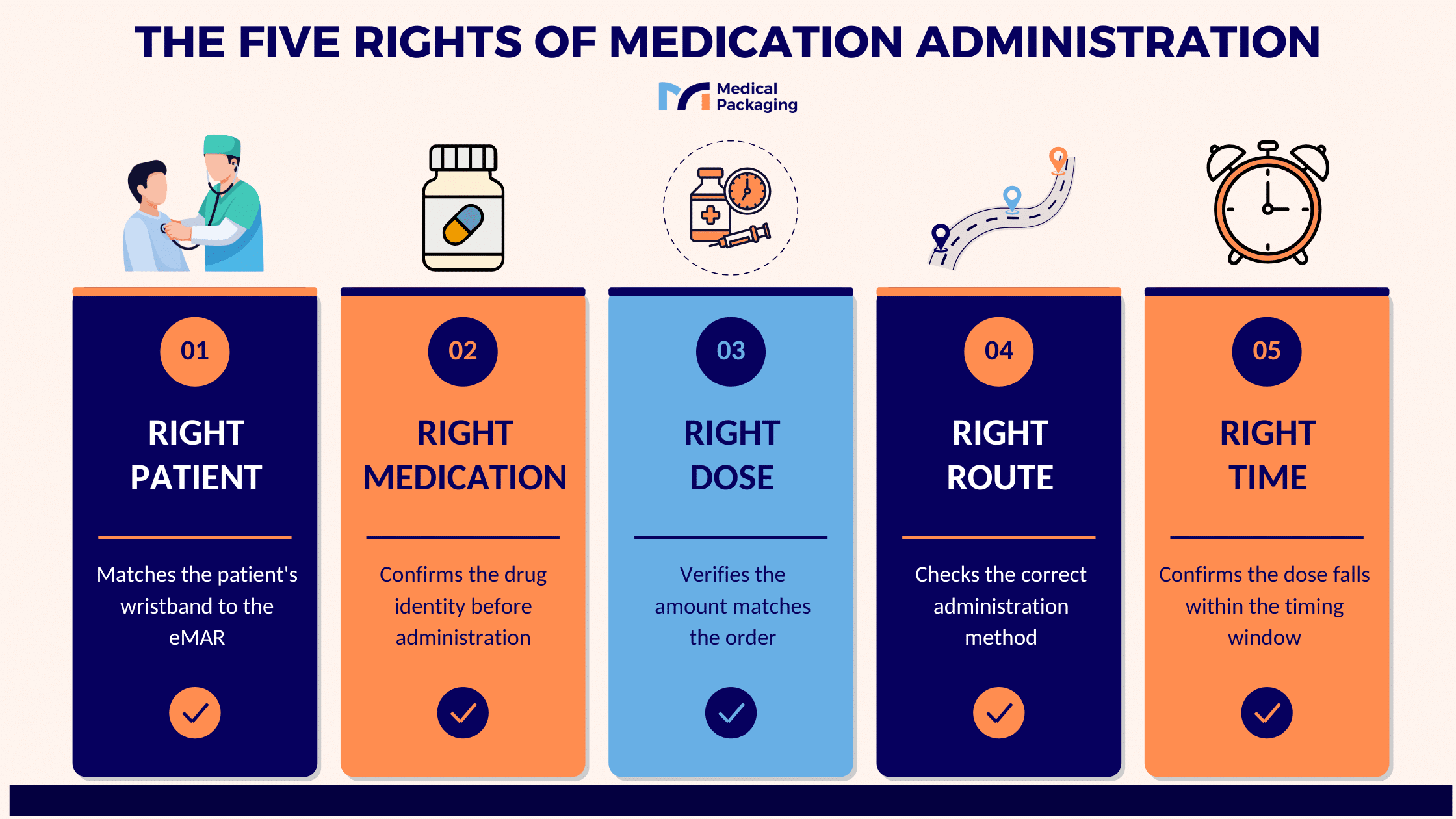
The Five Rights
Before any medication is administered, BCMA systems check five things in seconds. Each scan confirms a different piece of the puzzle — together, they form the verification chain that keeps patients safe.
BCMA technology has been widely studied. Research and systematic reviews have consistently shown that BCMA implementation reduces medication administration errors and adverse events in hospital settings. According to a literature review published in clinical practice journals, BCMA systems can reduce administration errors by more than 50% when used consistently.
The accuracy of the barcode on the unit dose package is what makes all of this possible. If the barcode can’t be read or encodes the wrong information, the entire verification chain breaks down.
Two Types of BCMA Failures and Why Both Start Upstream
Even in hospitals with established BCMA systems, medication administration errors tied to barcode failures remain a documented problem. But not all failures look the same. There are two distinct categories, and understanding the difference is the first step toward preventing them.
Readability Failures: Barcodes That Won’t Scan
Readability failures are the more visible of the two. The scanner can’t read the barcode, the system flags an error, and the nurse knows immediately something is wrong.
Common reasons scans fail:
Wrinkled, torn, or damaged labels
Low-contrast barcodes that scanners can’t distinguish
Labels placed over curved surfaces, seams, or package folds
Barcodes printed at insufficient resolution
Multiple barcodes on one package causing reader confusion
Labels that have smeared, faded, or peeled during handling
When a scan fails, nurses typically have three options: try scanning again, use a manual override, or find another unit of the medication. Manual overrides skip the verification step entirely, which defeats the purpose of BCMA technology. A published study found that workarounds were associated with medication administration errors at an adjusted odds ratio of 3.06, meaning administrations involving a workaround were roughly three times more likely to result in an error.
Keystroke Errors: Barcodes That Scan but Carry Wrong Information
Keystroke errors are the less visible and, in many pharmacies, the more common problem. The barcode scans without issue, the BCMA system accepts it, but the information encoded in that barcode was entered incorrectly when the label was created. A transposed NDC digit, a wrong expiration date, a lot number keyed in from the wrong bottle: none of these trigger a scan failure. They pass through silently, which is what makes them dangerous.
Common sources of keystroke errors in pharmacy labeling:
Manual NDC entry when adding drugs to a labeling system
Hand-keying lot numbers and expiration dates at the time of packaging
Transcription errors when pulling information from a manufacturer bottle
No structured verification step before packaged doses leave the pharmacy
The downstream effects of keystroke errors are harder to trace than scan failures, but the risk they introduce is significant. A barcode that scans correctly but contains wrong data provides a false sense of security at the point of care.
The Role of Unit Dose Packaging in Scan Accuracy
Why Unit Dose Matters
Unit dose packaging places a single medication dose in its own package, with its own barcode. That one-to-one relationship between dose and barcode is what makes BCMA work reliably. There’s no ambiguity about which dose is being scanned, no need to count tablets from a multi-dose bottle, and no opportunity for the wrong dose to be administered.
Unit dose packaging also reduces manual handling. Every time a nurse or pharmacy staff member opens, pours, or transfers medication, there’s an opportunity for error. A pre-packaged unit dose with a scannable barcode eliminates most of that handling.
Packaging Materials and Durability
The materials a unit dose is packaged in affect whether the barcode will still be readable by the time it’s scanned. Labels and packaging that can’t hold up to normal handling — transport from the pharmacy, storage in medication carts, removal from drawers — will cause scan failures.
What to look for in packaging materials:
Resistance to moisture and humidity, common in hospital environments
Minimal friction sensitivity so labels don’t smear during automated packaging
Thermal paper or film that maintains barcode contrast over time
Adhesive that stays in place without bubbling or peeling at the edges
Consistency Across Medications
When packaging formats vary significantly from one medication to another, nurses have to adapt their scanning technique for each one. Standardized packaging formats across a medication supply reduce that variability and support faster, more consistent medication scanning during busy shifts.
Label Design Best Practices for Reliable Scanning
Barcode Quality and Resolution
The resolution at which a barcode is printed determines whether a scanner can read it cleanly. Low-resolution barcodes appear pixelated, with uneven edges and inconsistent bar widths, all of which cause read failures.
Best practices:
Print at a resolution appropriate for the barcode symbology being used
Avoid scaling barcodes up or down after they’ve been generated
Use validated barcode labeling software to generate print-ready files rather than ad hoc design tools
Contrast and Readability
Barcode scanners read contrast — the difference between the dark bars and the light spaces between them. The higher the contrast, the more reliable the scan.
Black bars on a white background offer the best contrast
Avoid colored backgrounds, metallic or reflective label materials, and dark substrates
Label Size and Format
A barcode that’s too small or visually crowded is one of the most common reasons scans fail. Four elements determine whether a label works in practice:
Quiet zone: Clear white space on all sides so scanners can locate the barcode edges
Barcode size: Large enough to read at arm’s length with a handheld device
Label density: No clutter around the barcode — competing text and graphics cause read failures
Font size: Human-readable text legible without magnification for manual verification when scans fail
Human-Readable Information
Every medication label should include human-readable information alongside the barcode. When a scan fails and can’t be immediately resolved, pharmacy staff and nurses need to be able to verify drug name, strength, lot number, and expiration date by reading the label. That backup layer of verification supports safe medication practices even when technology doesn’t.
Barcode Placement: Small Detail, Big Impact
Where a barcode sits on a package matters as much as how it’s printed.Three placement rules cover most scan failures:
Avoid curved or folded surfaces. Barcodes placed on rounded packaging like the side of a syringe distort when a flat scanner tries to read them. Place labels on the flattest surface available.
Orient for handheld scanners. Nurses typically angle handheld devices from the side or slightly above. Labels should be readable from those angles without awkward repositioning.
Keep the barcode unobstructed. Seams, heat seals, and overlapping label edges all cause read failures. The full barcode, including quiet zones, should land on a clean, unbroken surface, and placement should be consistent across every unit in a batch.
Common Packaging, Labeling, and Data Entry Mistakes That Cause BCMA Failures
Most BCMA failures aren’t random. They trace back to a short list of recurring mistakes made during packaging, labeling, and data entry. Each one is preventable when caught at the design or setup stage, before medications reach the pharmacy floor.
Readability mistakes:
Printing barcodes at too low a resolution for the symbology being used
Placing labels on curved, folded, or seamed surfaces
Using label materials that smear, peel, or fade under normal handling conditions
Allowing barcode quiet zones to be crowded out by surrounding text or graphics
Failing to validate print quality before doses leave the packager
Data entry mistakes:
Manually keying NDC numbers when adding drugs to a labeling system, introducing transcription risk with every entry
Hand-entering lot numbers and expiration dates at the time of packaging rather than pulling them from the source
No pharmacist verification step before packaged doses are distributed
No documentation trail connecting a packaged dose to the staff member who created and verified it
How Automation Improves Barcode Accuracy
Manual labeling introduces variability that adds up fast across thousands of doses. Automated systems fix that in three ways:
Consistent label application. Labels land in the same position, with the same pressure, every time. Nurses and handheld devices can adapt to a predictable format.
Real-time barcode validation. Barcode labeling software flags unreadable barcodes before packages leave the pharmacy, stopping scan failures before they reach the bedside.
Standardized output across batches. The same pressure, speed, and alignment parameters apply to every unit, eliminating the inconsistencies that cause some doses in a lot to scan cleanly while others fail.
Supporting Compliance and Safety Standards
FDA regulations in place since 2004 require barcode labels on most prescription and over-the-counter hospital medications to include, at minimum, the National Drug Code (NDC) in a linear barcode format. That rule was designed specifically to support BCMA implementation and reduce medication error rates at the point of care.
Meeting that standard requires:
An FDA-compliant barcode on every unit dose
Traceability from lot number to individual package
Validated labeling processes that produce readable, durable barcodes consistently
For pharmaceutical manufacturers, contract drug manufacturing organizations, and hospital pharmacies that package their own medications, a validated labeling process and supporting documentation like an FDA-accepted Drug Master File are part of meeting that standard. BCMA compliance metrics are also a common patient safety indicator in hospital quality improvement programs, and reliable packaging feeds those numbers directly.
How MPI Helps Reduce BCMA Errors
MPI designs and manufactures packaging and labeling systems for the pharmaceutical and healthcare markets, with solutions that address both categories of BCMA failure: barcodes that can’t be read, and barcodes that contain wrong data.
Addressing Readability Issues
MPI’s automated packagers eliminate the label variability and print inconsistency that cause scan failures. The Auto-Print® 2, Auto-Print® Plus, Fluidose®, and Fluidose® Pharma systems are all available with a Barcode Verifier attachment that scans each package as it exits the machine. If a barcode doesn’t pass, the system stops, catching the problem before it compounds across a batch.
MPI’s full readability-focused product line:
Auto-Print® — automated unit dose blister packaging for oral solids with integrated barcode labeling
Fluidose® — automated fill-and-label for oral liquids and syringes in hospital and specialty pharmacy environments
Auto-Wrap® — syringe labeling system designed for curved surfaces where scan failures are most common
PABS — overwrapping system that protects barcode integrity through transport and storage
For print quality issues in the field, MPI’s technical support team responds within 24 hours and resolves most problems remotely.
First Data Bank integration — staff search and pull NDC and drug information from a verified national database instead of typing it manually
GS1/GTIN recall — scanning the manufacturer’s bottle at packaging pulls lot number, serial number, and expiration date automatically, with local expiration date calculated by the software
Integrated verification — pharmacists review, approve, or reject technician work within the software before or after packaging, with every packager and verifier documented on the packaging report
If your facility is working through BCMA scanning or data accuracy issues, contact the MPI team to find the right fit for your volume and workflow.
Final Thoughts: Getting BCMA Right Starts Before the Bedside
Barcode medication administration is a proven patient safety tool. But its effectiveness depends entirely on whether the barcode on each unit dose can actually be read, and whether the information it encodes is correct. When BCMA failures happen repeatedly, the problem is almost always upstream — in how medications are packaged, labeled, and entered into the system before they leave the pharmacy.
Every scan at the bedside is only as reliable as the packaging and labeling work that happened before it. Getting materials right, designing labels to spec, eliminating manual data entry, and building verification into the workflow are what turn a BCMA system into a genuine safety tool.
Why do barcode scans fail in hospitals?
Most barcode scan failures in hospitals trace back to packaging and labeling issues: barcodes printed at too low a resolution, labels placed on curved or folded surfaces, low contrast between the barcode and the label background, or labels that have peeled or smeared during handling. Scanner hardware and user technique play a role too, but upstream packaging is often the root cause.
What barcode format works best for medication labeling?
Linear barcodes (like Code 128 or ITF-14) are the FDA-required format for most pharmaceutical unit dose packaging and are widely supported by BCMA systems. Two-dimensional barcodes (like Data Matrix or QR codes) can store more information in a smaller footprint and are increasingly used in specialty pharmaceutical and syringe labeling where label real estate is limited. The right choice depends on what your BCMA system and handheld devices are configured to read.
How can hospitals improve BCMA compliance?
Start with the packaging. Work with pharmacy staff to document where and why scans fail, then trace those failures back to their source. Common fixes include standardizing label formats, switching to unit dose packaging for medications currently dispensed in multi-dose containers, auditing label placement for consistency, and using barcode validation software to catch unreadable barcodes before distribution. Training helps too, but training alone won’t fix a structural labeling problem.
What is a keystroke error in medication labeling, and why does it matter?
A keystroke error occurs when incorrect information — a wrong NDC, an inaccurate lot number, a mistyped expiration date — is entered manually when a medication label is created. Unlike a scan failure, a keystroke error doesn’t trigger an alert at the point of care. The barcode scans successfully, the BCMA system accepts it, and the wrong data passes through undetected. That’s what makes data entry accuracy as important as print quality in a reliable BCMA program.
How does barcode labeling software reduce manual data entry errors?
Purpose-built labeling software pulls verified data from trusted sources instead of requiring staff to type it. First Data Bank integration eliminates manual NDC entry. GS1/GTIN scanning pulls lot and expiration data directly from the manufacturer’s bottle. Built-in verification workflows require pharmacist sign-off before doses are distributed — closing the loop at every point where transcription errors occur.
MPI’s Drug Master File provides speed-to-market regulatory and technical support related to our packaging components for medical and pharmaceutical market clients